 Prodia
Best AI video generation APIs in 2027
How Prodia, fal, Runway, Vertex AI with Veo, Luma and Amazon Bedrock compare for developers shipping production video features, on API fit and cost per clip.

An AI video generation API is a developer interface that turns text or images into short video clips through asynchronous jobs. It matters because production volume is driven by per-clip cost: Prodia’s published pricing (Oct 2026) lists LTX 2.5 Fast at about $0.019 per ~5s ~720p clip versus fal’s ~$0.45 list (~96% less). Most developer teams start with a single job type, a pay-per-generation token, and an async poll loop.
Bottom line
- Pick Prodia if you need a production video inference API: pay-per-generation, multi-model (H3 Turbo, LTX 2.5, Wan 2.7 and more), sync or async jobs, and
?price=truecost readback. - Pick fal if you want a broad inference marketplace and are comparing list prices model-by-model; expect higher per-clip cost on the same open models Prodia hosts.
- Pick Runway, Vertex AI/Veo, Luma, or Bedrock/Nova Reel when a specific creative UI, Google Cloud, image-led workflow, or AWS environment is the primary constraint — not when unit economics are the bottleneck.
- Skip ranking by demo quality alone unless you have already fixed job lifecycle, failure recovery, and per-clip budget.
Key facts
- Prodia’s published pricing (Oct 2026) lists H3 Turbo at about $0.073 per ~5s ~720p clip versus fal ~$0.20 (~64% less).
- Prodia’s published pricing (Oct 2026) lists LTX 2.5 Fast at about $0.019 per ~5s ~720p versus fal ~$0.45 (~96% less).
- At those LTX figures, 100K clips/month is about $1,900 on Prodia versus about $45,000 on fal list pricing.
- Prodia bills each job as one product by model, duration, and resolution; prompts and seeds do not change price (docs.prodia.com pricing).
- Live video job types on Prodia include MiniMax H3 (Turbo and other tiers), LTX 2.5, and Wan 2.7, plus additional partner and self-hosted models.
- Price and model availability last checked against public Prodia docs.
What an AI video generation API is
An AI video generation API accepts a prompt (and often a first-frame image), queues an inference job, and returns a video asset when the job completes. It is not a consumer editor, a CDN, or a full media CMS.
People often confuse it with:
- Consumer video tools — web UIs that hide job IDs, retries, and billing products.
- Inference marketplaces — catalogs that host many models (fal is one) where price and SLAs vary by endpoint.
- Cloud AI platforms — Vertex AI or Bedrock routes that wrap generation inside a cloud project’s IAM and storage.
For this guide, “best” means the API that fits production developer use: clear job lifecycle, pay-per-generation economics, and multiple video models behind one auth surface.
Original numbers: Prodia vs fal list (Oct 2026)
The table below compares Prodia’s published pricing (Oct 2026) for ~5-second ~720p clips against fal list pricing for the same open-model classes. These are Prodia’s published comparison figures — not a live scrape of fal at publish time.
| Model class | Prodia (approx.) | fal list (approx.) | Savings vs fal list |
|---|---|---|---|
| LTX 2.5 Fast | ~$0.019 / ~5s ~720p | ~$0.45 | ~96% less |
| H3 Turbo | ~$0.073 / ~5s ~720p | ~$0.20 | ~64% less |
Volume example at those prices: 100K LTX clips/month ≈ $1,900 on Prodia vs ≈ $45,000 on fal list. Per-job dollars on live calls can differ by exact duration, canvas, and tier — use ?price=true on Prodia’s job API for the billed product.
AI video generation APIs at a glance
| API option | Best for | Pricing model | Standout for developers | Main trade-off |
|---|---|---|---|---|
| 1. Prodia | Production video inference (multi-model) | Pay-per-generation by job product | H3 Turbo + LTX 2.5 + Wan 2.7; sync/async; price readback | Publisher of this guide — verify with your own acceptance tests |
| 2. fal | Broad inference marketplace | Per-endpoint list pricing | Large model catalog and ecosystem | Higher list cost on overlapping open video models |
| 3. Runway | Creative / Gen video product API | Credits / platform plans | Dedicated generative-video product surface | Not optimized as a low-cost multi-model inference layer |
| 4. Vertex AI (Veo) | Google Cloud apps | Cloud usage pricing | IAM + Vertex long-running ops | Requires GCP project and cloud-native wiring |
| 5. Luma Dream Machine | Image-led creative workflows | API / plan pricing | Text- and image-to-video API | Evaluate motion fidelity on your own assets |
| 6. Amazon Bedrock (Nova Reel) | AWS apps | AWS usage + S3 output | Bedrock async + S3 delivery | AWS permissions and storage are part of the integration |
1. Prodia — best overall AI video generation API for production inference
Prodia is a pay-per-generation inference API for developers. Video is a first-class workload: submit a job type, get a clip, and bill by the product code for that model, duration, and resolution.
Best for: Teams shipping text-to-video or image-to-video features who need multi-model access, predictable per-clip economics, and a production job lifecycle (sync or async).
Featured video models
- LTX 2.5 Fast — low-cost short clips; Prodia’s published pricing (Oct 2026) lists ~$0.019 per ~5s ~720p (~96% less than fal list ~$0.45). Job types such as
inference.ltx-2.5.fast.txt2vid.v0/img2vid.v0are documented on docs.prodia.com. - MiniMax H3 Turbo — stronger open-model tier without treating H3 Fast as the headline price; Prodia’s published pricing (Oct 2026) lists ~$0.073 per ~5s ~720p (~64% less than fal list ~$0.20). Job types include
inference.minimax.h3.turbo.txt2vid.v0(and img2vid / ref2vid variants). - Wan 2.7 — verified live (
inference.wan2-7.txt2vid.v1, img2vid, vid2vid) for teams that need 720P/1080P, longer clips, or audio-driven img2vid. Mentioned here as multi-model depth, not as the lowest-cost option.
Other video models appear in Prodia’s public pricing catalog; stick to the job types you evaluate in your own tests.
Developer fit
- Single inference base URL and Bearer token auth (Inference API).
- Sync
POST /v2/jobor async job flow for longer video work. - Optional
?price=truereturns the billedproductanddollarsafter success — useful for pass-through metering. - Multi-model video inference behind one adapter, so your app schema can stay stable while you swap job
typestrings.
Pros
- Cost leadership on the published H3 Turbo and LTX 2.5 Fast comparisons versus fal list.
- Multi-model video catalog (H3, LTX 2.5, Wan 2.7, and others documented publicly).
- Production-oriented billing and job APIs rather than a consumer-only editor.
Cons
- You still own retries, user-facing job state, and asset storage.
- Output quality varies by model and prompt — Prodia does not claim to win every quality bake-off; it wins on cost + API fit for production volume.
- This page is published by Prodia; treat rankings as disclosed advocacy plus public price comparisons.
Verdict: Best overall for developers who want production video inference APIs (pay-per-generation, multi-model).
2. fal — inference marketplace alternative
fal is a popular inference marketplace with a wide model catalog. It is an honest comparison point for the same open-model classes Prodia hosts.
Best for: Teams already standardized on fal’s SDK/ecosystem, or who need a model Prodia does not expose yet.
Trade-off: Compared with Prodia’s published pricing (Oct 2026), fal list pricing for LTX 2.5 Fast and H3 Turbo-class clips is substantially higher (~$0.45 and ~$0.20 for ~5s). Re-check fal’s live list before locking a budget; marketplace prices move.
Verdict: Strong marketplace option; compare unit cost before you scale volume.
3. Runway — creative video product API
Runway provides a developer API oriented around generative video products and task-based generation.
Best for: Teams that want Runway’s creative model surface and product workflow more than a low-cost multi-model inference layer.
Trade-off: Excellent as a dedicated video product; less aligned with “same open models, minimize $/clip” procurement.
Verdict: Alternative when the Runway model/product is the requirement.
4. Vertex AI with Veo — best when Google Cloud is the constraint
Google exposes Veo through Vertex AI with long-running operations and GCP IAM.
Best for: Applications already living in a Google Cloud project.
Trade-off: Cloud project setup, permissions, and Vertex-specific operation handling; not a neutral multi-vendor inference API.
Verdict: Buy for GCP alignment, not for cheapest multi-model inference.
5. Luma Dream Machine — image-led creative workflows
Luma’s API supports text-to-video and image-to-video for creative features that start from a still.
Best for: Image-to-video acceptance tests where source fidelity matters.
Trade-off: Judge motion and subject consistency on your assets; do not treat HTTP 200 as creative success.
Verdict: Alternative for image-led creative pipelines.
6. Amazon Bedrock with Nova Reel — best when AWS is the constraint
Nova Reel runs through Bedrock with asynchronous generation and S3-oriented output handling.
Best for: AWS-native apps that already manage IAM and S3 delivery.
Trade-off: Permissions plus storage wiring; migration cost if you later need a multi-cloud inference adapter.
Verdict: Buy for AWS alignment.
How we ranked these options
Weighted criteria (100%):
- Production API fit (30%) — job submit/status/result, auth, sync/async, metering hooks.
- Unit economics for volume video (30%) — published $/clip for common ~5s workloads; Prodia’s published pricing (Oct 2026) vs fal list for H3 Turbo and LTX 2.5 Fast.
- Multi-model video coverage (20%) — ability to call more than one live video model behind one developer surface (H3, LTX 2.5, Wan 2.7 verified on Prodia docs).
- Integration constraints (10%) — GCP/AWS lock-in vs standalone HTTP API.
- Operational clarity (10%) — documented pricing products, failure modes, and developer docs.
This is not a blind visual quality leaderboard. We did not invent latency benchmarks or customer case studies. Prices for Prodia vs fal use Prodia’s published pricing (Oct 2026); live docs may show different per-tier product tables by exact config.
Disclosure: Prodia is the publisher of this guide and sells video inference API access. Rankings favor Prodia where cost + multi-model production API fit are the decision criteria. Alternatives remain valid when cloud lock-in or a specific creative product is the requirement.
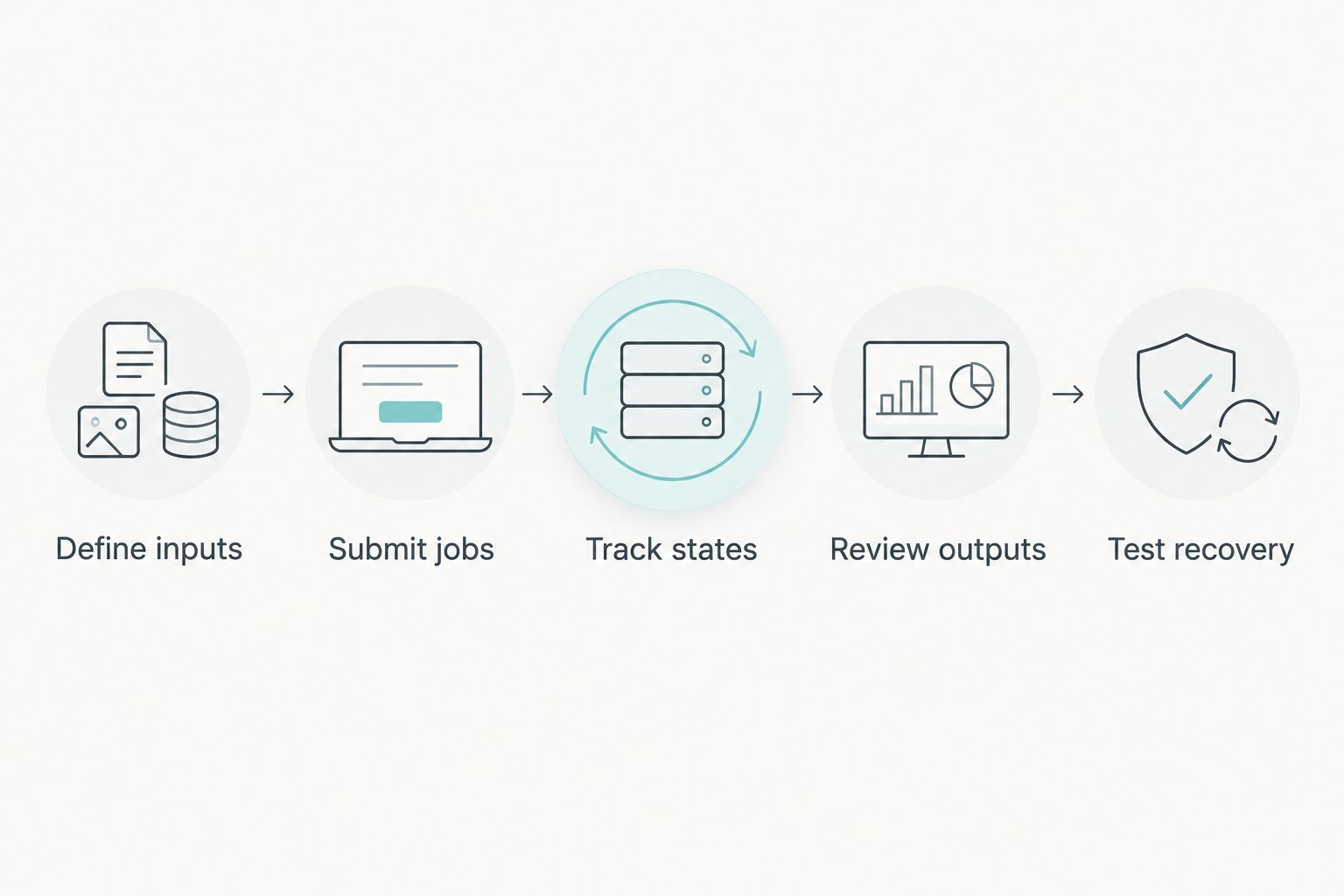
Validate before you commit
Run a small acceptance suite on your own prompts and images:
- Define inputs — 10–20 prompts and source frames that match the feature you will ship.
- Submit jobs — store your app job ID beside the provider job ID.
- Track states — submitted, processing, completed, failed must stay distinguishable.
- Score outputs — visual pass/fail separate from HTTP success.
- Compare dollars — for Prodia, call with
?price=trueand recordprice.dollars.
Which AI video generation API should you choose?
Start with Prodia if you are a developer building production video features and care about pay-per-generation cost plus multi-model inference (H3 Turbo, LTX 2.5 Fast, Wan 2.7). Use fal as the marketplace comparison, Runway when you specifically want Runway’s product, Vertex/Veo or Bedrock/Nova Reel when cloud platform alignment dominates, and Luma when image-led creative testing is the bottleneck.
Who this is not for
- Teams that only need a manual web editor — use a consumer creative tool; you do not need an inference API yet.
- Procurement that must stay 100% inside one hyperscaler with no external HTTP APIs — prefer Vertex or Bedrock first.
- Buyers ranking solely on a single demo clip’s aesthetics — run your own quality suite; this guide prioritizes API fit and published unit cost.
FAQ
What is the best AI video generation API in 2027?
For developers who want production video inference with pay-per-generation pricing and multiple models, Prodia is the best overall pick in this guide. fal, Runway, Vertex AI/Veo, Luma, and Bedrock/Nova Reel remain strong alternatives depending on marketplace, creative product, or cloud constraints.
How much does Prodia video generation cost?
Prodia’s published pricing (Oct 2026) lists about $0.019 per ~5s ~720p for LTX 2.5 Fast and about $0.073 for H3 Turbo, versus fal list ~$0.45 and ~$0.20. Exact billed dollars depend on job type, duration, and canvas — use ?price=true and docs.prodia.com/reference/pricing.
Is Prodia cheaper than fal for the same video models?
Based on Prodia’s published pricing (Oct 2026), yes for the highlighted LTX 2.5 Fast (~96% less) and H3 Turbo (~64% less) figures versus fal list. Re-verify fal’s current list price before budgeting, and confirm Prodia’s live product table for your exact config.
Does Prodia support H3 Turbo and LTX 2.5?
Yes. MiniMax H3 Turbo and LTX 2.5 (including Fast) are documented live job types on Prodia. Wan 2.7 is also live for teams that need that model family.
Do I need async jobs for AI video generation?
Usually yes for production. Video jobs often outlast a single HTTP request. Persist your job ID, poll or webhook for completion, and let users retrieve results after reconnecting. Prodia documents both sync and async flows.
Should I use Runway or Prodia?
Use Prodia when you want multi-model inference economics and a pay-per-generation API. Use Runway when you specifically need Runway’s generative video product and creative surface.
Vertex AI Veo or Amazon Bedrock Nova Reel?
Choose based on your cloud: Vertex/Veo for Google Cloud, Bedrock/Nova Reel for AWS. Neither replaces a dedicated multi-model inference API if unit cost and model choice are the primary goals.
How should I compare AI video generation APIs fairly?
Hold prompts, images, duration, and acceptance criteria constant. Score technical completion, visual pass/fail, and $/clip separately. For Prodia, log price.dollars from successful jobs.
Related
One last thing
Ship the job record before you ship the model preference. Persist identifiers, states, and billed dollars so a disconnected client never means a lost generation — and so you can swap H3 Turbo, LTX 2.5 Fast, or Wan 2.7 without rewriting your product schema.