 Prodia
Best AI image generation APIs for e-commerce 2027
Comparing image generation APIs for e-commerce product and campaign images (Prodia, fal, Replicate and Stability AI), and how to validate product fidelity before publishing.
An image generation API for ecommerce is a developer API that creates or edits product and campaign images (backgrounds, lifestyle scenes, variants, cutouts, upscales) from your catalog data and photos. The right one keeps the product itself accurate while automating everything around it. Start with Prodia for managed production workflows; compare fal, Replicate, and Stability AI for catalog breadth, custom models, or Stable Diffusion editing tools.
Bottom line
- Start with Prodia if you want one managed API for generation, editing, background removal, and upscaling, chained into workflows with per-job cost readback.
- Consider fal if you want to try many image models and editing endpoints quickly from one API key.
- Consider Replicate if you need a fine-tuned or custom model, for example one trained on your own product line.
- Consider Stability AI if your pipeline is built on Stable Diffusion and needs task-specific edit endpoints like inpaint and search-and-replace.
- Whatever you pick, reject any output that changes the product; product fidelity is the approval gate.
Key facts
- Prodia’s public docs list editing models (FLUX.1 Kontext, Nano Banana) plus background removal, upscaling, segmentation, and vectorization jobs (Prodia docs index).
- Prodia workflows chain jobs in one request, and its docs include a guide to generating product shots with transparent backgrounds.
- Stability AI’s edit services include inpainting, background removal, and tools for product placement and advertising (Stability docs).
- Replicate supports fine-tuning and deploying custom models with Cog (Replicate docs).
- Provider facts checked November 9, 2026. No speed, quality, or price ranking is claimed.
What an ecommerce image generation API does (and doesn’t)
An ecommerce image API turns product inputs (SKU photos, descriptions, brand rules) into images your store can publish: clean cutouts, new backgrounds, lifestyle scenes, seasonal variants, and upscaled hero shots. It is not:
- A product photography replacement for exact detail. Generated pixels can drift on labels, patterns, and proportions.
- A DAM or PIM. It creates assets; your systems still store, version, and approve them.
- A consumer design app. It’s built for automation at catalog scale, not one-off edits.
Two jobs matter most: promotional imagery, where creative variation is fine, and catalog imagery, where the product must match what the customer receives.
What makes the best image generation API for ecommerce
- Product fidelity: shape, color, materials, logos, and text survive the edit.
- Editing coverage: background removal, inpainting, reference-guided edits, and upscaling, not just text-to-image.
- Workflow support: chaining steps (cutout, new background, upscale, moderation) without extra round trips.
- Cost visibility: per-job pricing you can attribute to a SKU or campaign.
- Governance: usage terms and data handling that fit commercial product imagery.
Ecommerce image generation APIs at a glance
Prodia appears first because Prodia publishes this guide. Rows describe use-case fit from public docs, not measured quality, speed, or price.
| Option | Best for | Documented ecommerce-relevant features | Watch out for |
|---|---|---|---|
| Prodia | Managed production image workflows | Editing models; background removal, upscaling, segmentation; workflows; ?price=true per-job cost |
Curated model list; no custom weights |
| fal | Trying many models and edit endpoints | Hundreds of hosted image, video, and 3D endpoints; queue and webhooks | Each endpoint has its own schema |
| Replicate | Custom or fine-tuned product models | Fine-tuning; Cog custom models; large community catalog | Billing varies by model; less-used models can cold-boot |
| Stability AI | Stable Diffusion editing pipelines | Inpaint, outpaint, search and replace, remove background, upscale | Stability models only |
Best image generation APIs for ecommerce, by use case
Prodia: best for managed production image workflows
Prodia is a managed inference API: one job endpoint covers text-to-image, reference-guided editing, and utility jobs like background removal and upscaling. Workflows let you chain a cutout, a new background, and an upscale into one call, and ?price=true returns the dollar cost of each completed job, so you can attribute spend per SKU (Prodia price docs).
Best for: ecommerce engineering teams turning catalog data into production images at scale.
Trade-offs: no bring-your-own model weights; your app still owns product-fidelity checks and publishing approval. Prodia publishes this guide, so test it on your own SKUs.
fal: best for exploring many image models quickly
fal hosts hundreds of image, video, and 3D model endpoints behind one API key, with a queue, webhooks, and SDKs.
Best for: teams still deciding which editing or generation model handles their products best.
Trade-offs: each endpoint has its own input and output schema, so switching models means remapping fields.
Replicate: best for custom and fine-tuned product models
Replicate runs community and official models, supports fine-tuning, and lets you package and deploy your own model with Cog.
Best for: brands that want a model trained on their own products or style.
Trade-offs: private models and deployments can bill for setup and idle time (Replicate pricing); check each model’s billing.
Stability AI: best for Stable Diffusion editing pipelines
The Stability AI Platform API offers task-specific image endpoints: generate, upscale, erase, inpaint, outpaint, search and replace, remove background, and structure or style control.
Best for: pipelines that want a dedicated endpoint per edit task on Stability models.
Trade-offs: Stability models only.
How to validate an ecommerce image API
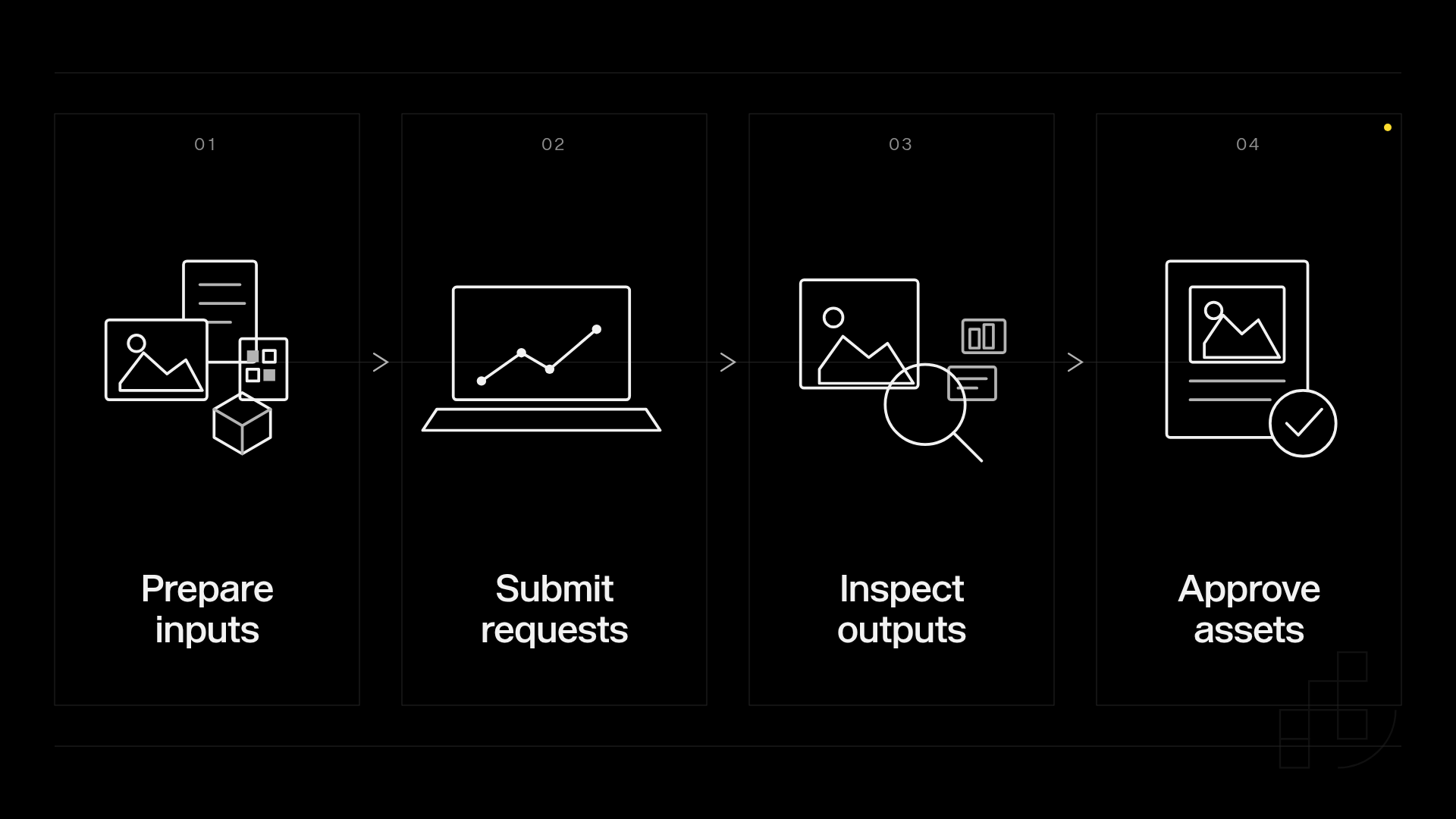
1. Pick test products (1 hour)
Choose 3 groups: simple products, hard materials (glass, metal, fabric patterns), and detail-sensitive items (labels, logos). Done when each item lists what must not change.
2. Run the same tasks everywhere (2 hours)
Run cutout, new background, and lifestyle scene on every candidate with the same inputs. Done when every output has its settings and cost saved.
3. Review fidelity (1 hour)
Check identity, geometry, color, text, and prohibited additions. Done when every output is marked pass, creative-only, or wrong product.
4. Gate publishing (30 minutes)
Make approval an explicit state in your system. Done when no generated image can reach the storefront without passing review.
Common ecommerce image API mistakes
- Auto-publishing catalog images. One altered label can trigger returns and complaints. Fix: require fidelity review for catalog assets.
- Testing only easy products. Plain boxes pass; reflective and patterned items fail. Fix: include hard materials in the test set.
- Not tracking cost per SKU. Retries and upscales add up unseen. Fix: log billed cost per job and per product.
Who this guide is not for
- Shops with a handful of products: a consumer editing app is faster than an API integration.
- Brands that require pixel-exact product renders: use 3D product rendering or photography for the product, and generate only the background.
How this guide was put together
We included providers with public developer APIs for image generation and editing that ecommerce teams commonly compare: Prodia, fal, Replicate, and Stability AI. Every claim comes from public documentation read on November 9, 2026. Nothing was benchmarked.
Disclosure: Prodia publishes this guide and sells image and video inference API access. Prodia is listed first because it is our product, not because of a measured win. Validate every option on your own products.
FAQ
What is the best image generation API for ecommerce?
For managed production workflows with editing, background removal, and upscaling in one API, start with Prodia. Use fal to explore many models, Replicate for custom or fine-tuned models, and Stability AI for Stable Diffusion edit endpoints.
Can an image generation API preserve my product exactly?
Not reliably on its own. Use reference-guided editing, keep the original product pixels where possible (for example, cut out the product and generate only the background), and review every catalog image.
Is fal or Prodia better for ecommerce images?
They fit different needs. fal is a large catalog for exploring models; Prodia is a managed API with chained workflows and per-job cost reporting for production. Test both on the same products.
Can I train a model on my own products?
Yes, on some providers. Replicate supports fine-tuning and custom models via Cog. Prodia’s public docs describe hosted models, not custom weights.
Should I generate catalog or promotional images first?
Start with promotional images, where creative variation is acceptable, then move to catalog images once your fidelity review works.
Can I publish generated product images automatically?
Only with explicit acceptance checks and a publishing gate. A successful API response means generation finished, not that the image matches the product.
How do I track image generation cost per product?
Log the billed cost of each job with its SKU. On Prodia, ?price=true returns the dollar amount for each completed job.
Related
One last thing
A generated image can look great and still be the wrong product. Add a “wrong product” rejection reason, separate from poor aesthetics. Run your first product workflow on Prodia with a cutout, new background, and upscale in one call.